

The Hidden Freight Cost of EPS: How Nestable Packaging Cuts Warehouse Footprints
When evaluating protective packaging for products weighing anywhere from 10 to 100 pounds—like pumps, motors, gearboxes, or power tools—the conversation usually focuses on drop protection and material costs. But there is another major factor that directly impacts your bottom line: warehouse space and logistics efficiency.
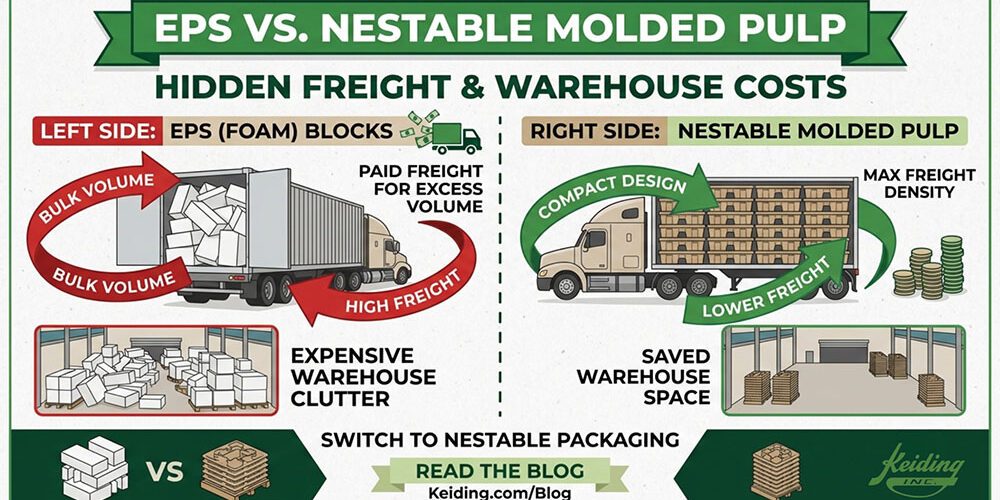
If you rely on expanded polystyrene (EPS) foam blocks or thick plastic inserts, you are paying for space you aren’t using. Because rigid EPS foam inserts cannot nest tightly inside one another, you end up paying to ship and store bulk air.
At Keiding, we design and manufacture renewable, heavy-wall molded pulp solutions that protect your heavy parts while streamlining your entire packaging operation.
1. Eliminate the “Ghost Cost” of Bulk Storage
EPS foam and rigid plastic components take up massive amounts of square footage on your warehouse floor. Because they are bulky and rigid, incoming shipments of foam arrive on tall, low-density pallets that quickly crowd your storage racks.
By switching to nestable molded pulp packaging, your incoming protective inserts stack compactly inside one another. This drastically reduces the total pallet volume required for raw packaging inventory, freeing up valuable warehouse floor space for finished goods and active manufacturing lines.
2. Cut Inbound Freight and Transportation Expenses
Paying for full truckloads of lightweight, bulky EPS foam means you are paying high freight rates to transport empty space.
Because Keiding’s molded pulp packaging features time-saving, nestable designs, you can fit significantly more protective parts onto a single pallet and inside every incoming trailer. Freight efficiencies mean:
- Fewer inbound truck trips needed to restock packaging materials.
- Lower overall transportation costs per unit packaged.
- Better utilization of freight volume throughout your supply chain.
3. Improve Assembly Line & Production Flow
Storage efficiency doesn’t end in the warehouse—it impacts the assembly floor.
Large stacks of non-nestable foam force packers to spend extra time retrieving inventory or managing clutter around their workstations. Nestable molded pulp inserts fit in compact, manageable stacks right at the packing station. This leads to time-saving production operations, allowing workers to quickly grab blocking, bracing, or support inserts without losing momentum.
4. Heavy-Duty Protection Without the Eco-Trade-Off
Space savings mean little if your packaging fails in transit. Keiding’s Type 1 heavy-wall molded pulp provides rugged, reliable, and recyclable protection designed to meet rigorous ISTA testing requirements for heavy industrial and commercial applications.
By upgrading to nestable molded pulp, you get:
- Outstanding blocking, bracing, and support capabilities for items up to 100+ lbs.
- A 100% recyclable and renewable alternative to EPS foam.
- Significant savings in warehouse storage footprint and transportation overhead.
Update Your Packaging with Renewable Molded Pulp
Ready to stop paying to store and ship empty space? Take advantage of Keiding’s decades of experience in designing custom molded pulp packaging.
Contact the Keiding design team today to get a fast and free design evaluation for your industrial, commercial, or consumer products.